
The First Mistake: Treating Every Dent Like It's the Same Dent
Someone backs the car bumper into the door, or a stray baseball finds its mark, and within five minutes there's a YouTube video queued up showing a guy popping a dent out with a plunger or a wooden block and a hammer. It's tempting because the door still looks like one flat sheet of steel, and if a plunger can fix a car panel, why not a garage door?
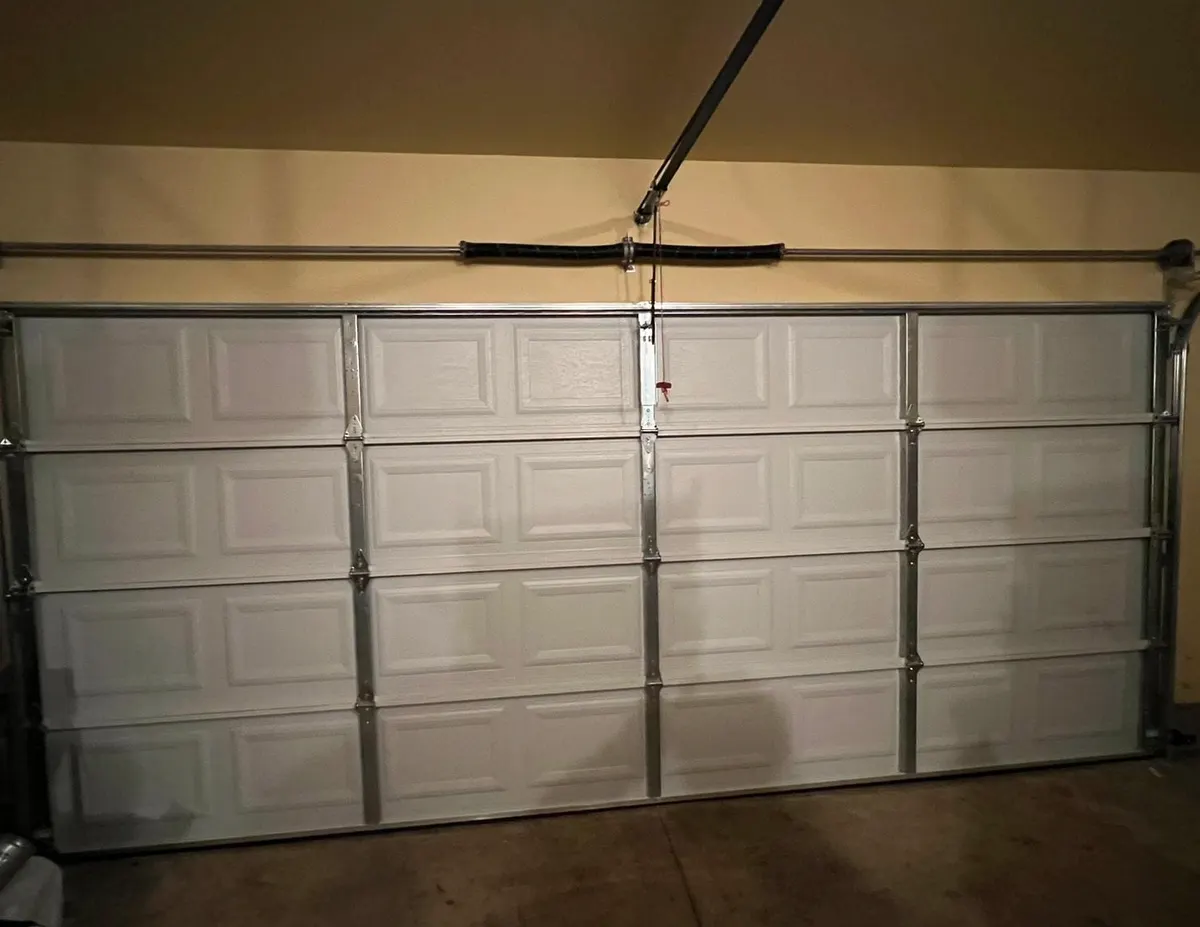
Here's the problem: a garage door isn't one sheet of steel. It's a sandwich of a thin steel face, insulation foam, a back skin, and in most panels, a steel reinforcement strut running horizontally for stiffness. Hammering or suction-pulling on the front skin can separate the layers, crack the foam bond, or bend the strut you can't even see. You might flatten the visible dent and still end up with a door that's weaker than before you touched it.
Dents That Are Genuinely Cosmetic
Some dents really are just a bad day for the paint. You're probably fine if:
- The dent is in the flat center of a panel, away from hinges, the track side, or panel seams.
- It's shallow and rounded, with no sharp crease or fold line.
- The door still opens and closes smoothly, with no scraping, binding, or new noise.
- Running your hand across it, you don't feel a ridge where metal has actually bent rather than just dimpled.
These are the dents you can live with, or have smoothed and repainted without touching the door's function. It's a cosmetic fix, not a safety issue.
Dents That Are Actually Structural
The argument-settler is this: location matters more than size. A dent is structural, not cosmetic, if it shows up in any of these spots:
- Near a hinge or roller bracket — even a small dent here can twist the bracket alignment, which throws the whole panel off track.
- Along the vertical edge where panels meet the track — this bends the stile, and a bent stile means the rollers no longer ride straight, which is why the door starts to bind or jump the track.
- Over the reinforcement strut — you often can't see the strut, but if the dent has a hard crease rather than a soft dimple, assume the strut bent with it.
- On a wind-rated panel's bracing points — doors built to meet wind-load requirements rely on their bracing being intact at specific points along the panel; a dent there isn't just ugly, it can reduce the door's rated resistance in a storm.
If the door binds, drags, or closes unevenly after the dent happened, that's your answer right there. It's structural, and no amount of panel-beating at home fixes the alignment problem underneath.
Why This Matters More Here Than in a Dry Climate
In Citrus County's heat and humidity, a dent does something a drier climate wouldn't necessarily do: it cracks the paint seal right at the deepest point of the bend. That crack becomes a spot where afternoon downpours sit and soak in instead of running off. Over a season or two, that's where rust starts, working from the inside of the dent outward, and where moisture gets into the foam core and causes it to swell. A small cosmetic dent left untreated through a wet summer can turn into a soft, rust-stained spot that is no longer cosmetic at all.
This is also why, heading into another hurricane season, a dent on a wind-rated door isn't something to shrug off. If your door carries a wind-load rating, its ability to hold up in a storm depends on every bracing point doing its job. A dent that's bent a strut or thrown off a bracket is a dent that's quietly lowered your door's real-world wind resistance, no matter what the sticker on the panel still says.
When to Call Inverness Overhead Door Co
If the dent is near a hinge, track, or strut, or if the door isn't moving the way it used to, that's the point to call rather than guess. We'll check roller and track alignment first, since that tells us whether the panel is just cosmetically dinged or actually bent out of true. Depending on what we find, that might mean a simple off track door repair to get the rollers back in line, or in cases where the panel itself is compromised, a panel or full new garage door installation rather than a patch that won't hold through next year's storm season.
If you're in Inverness, Lecanto, Hernando, Crystal River, Homosassa, Floral City, Beverly Hills, or Citrus Springs and you're staring at a dent trying to decide who's right, give us a call at our US-41 Inverness location. We'll settle it in about ten minutes, for free.